
Red Light Is Having a Moment. But What Are You Actually Getting?
From guest blogger Ana Kat, Director of Renew Wellness Center
With a foundation in Eastern medicine and a passion for whole-person wellness, Ana Kat takes a multifaceted approach to helping people feel their best. As Director of Renew at Western Racquet & Fitness Club, she works with clients to explore personalized wellness strategies and supportive care plans that may incorporate modalities such as red light therapy, PEMF, and sound vibration therapy.
Ana also specializes in energy healing and leads breathwork sessions, with a particular interest in supporting people who are navigating chronic health concerns. Her approach combines her background in Eastern medicine with an ongoing curiosity about emerging wellness technologies and how they may fit into an individual’s overall routine.
In this guest blog, Ana takes a closer look at one of the wellness world's current favorites: red light therapy. With red light panels, masks, saunas, and full-body systems becoming increasingly common, it can be hard to know what you’re actually getting and whether or not it’s effective.
Here’s what to know about wavelengths, infrared heat, treatment dose, and why that glowing red light might not always be doing what you think.
Red Light is Having a Moment
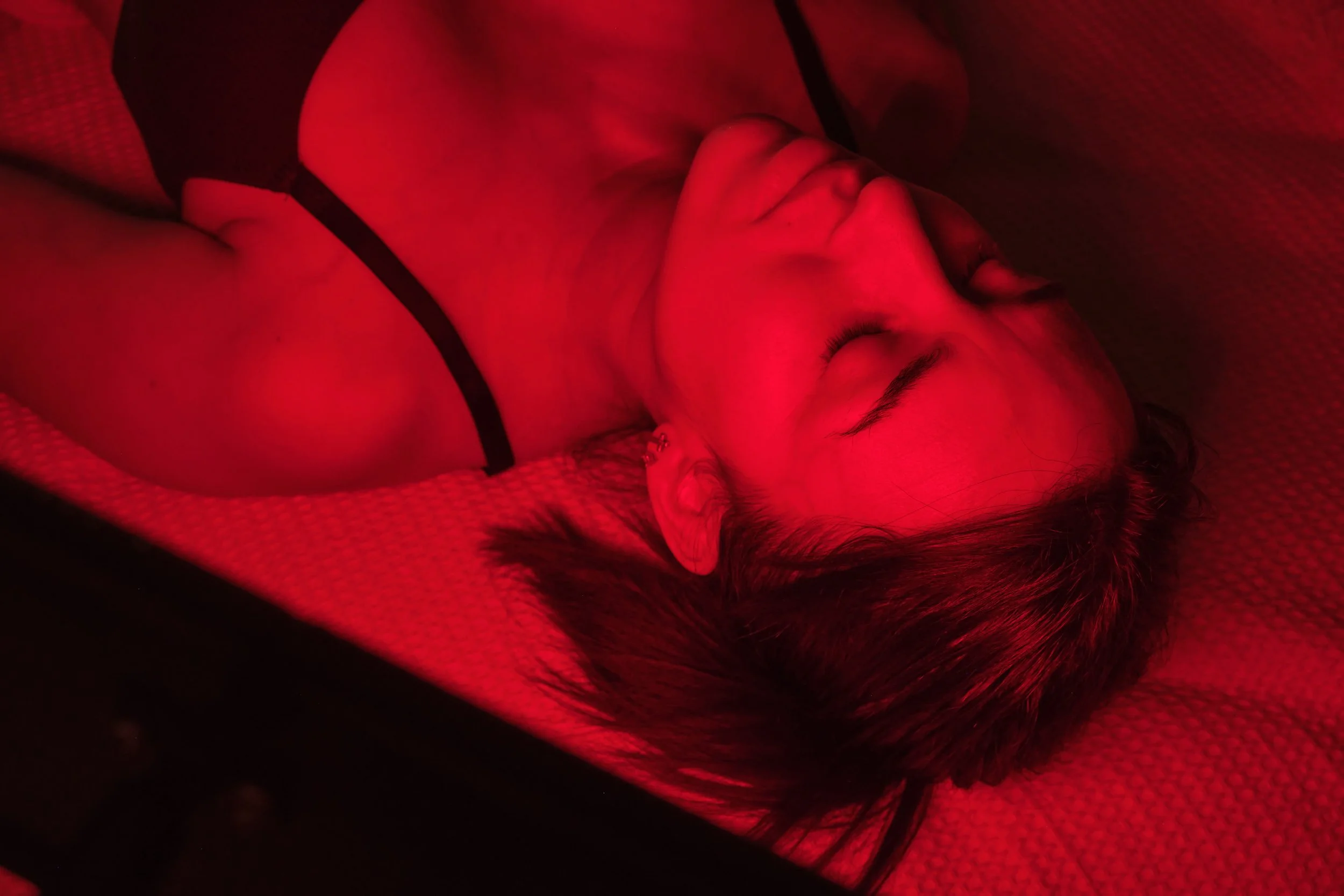
Red light seems to be everywhere lately—influencers offering special offers, Kylie Jenner selling face masks, full-body panels for home use, and even yoga and workout classes offered immersed in glowing red.
All of these options are described as “red light” or “infrared,” but they aren’t necessarily doing the same thing.
So let’s make this a little less confusing. First, what is red light therapy?
Red light therapy uses low levels of red and sometimes near-infrared light. Researchers have studied it and continue to study it for a wide range of applications, including skin health, wound healing, exercise recovery, general wellness, and more. There is some promising research, but there is also a lot we still don’t know. You’ll find plenty of big claims about red light therapy online, but the research doesn’t support every use or every promise you’ll see advertised.
Red Light Isn’t Always Red
One of the questions I get a lot is whether your skin actually needs to be exposed for red light therapy.
The answer: ideally, yes.
If we’re trying to deliver light to the body, we want as little between the light source and your skin as possible. Clothing can absorb or reduce some of that light, so following the device’s recommendations about exposure matters.
Then there’s wavelength, which is probably one of the most important pieces people don’t always think about.
Visible red light is generally in the 600-nanometer range and is commonly used when we’re interested in more superficial tissue, including the skin.
Near-infrared light uses longer wavelengths, often in the 800-nanometer range. This is light we can’t actually see. These wavelengths can penetrate farther into tissue, which is one reason near-infrared is often included in systems being used for muscle, joint, and exercise recovery.
So, kind of interesting: some of the light we’re most interested in during “red light” therapy isn’t actually red to our eyes at all.
Red Light or Infrared Heat?
This is where things can get confusing.
Infrared can also be used to create heat. Think infrared sauna or some of the heated yoga and fitness studios popping up everywhere.
That heat may feel great. It can increase skin blood flow, make you sweat, and change how a workout feels. But an infrared-heated room and red or near-infrared light therapy are not automatically the same treatment. And heat isn’t automatically beneficial just because we’re sweating.
For some people, exercising in significant heat adds another stressor on top of the workout. You lose more fluid, your heart has to work harder to help regulate body temperature, and if you’re someone who doesn’t tolerate heat particularly well, more isn’t necessarily better.
That doesn’t make heated yoga or infrared heat “bad.” It just means we should stop assuming that because something is hot, makes us sweat, and has the word infrared attached to it, it must be doing the same thing as red light therapy.
No shade to a beautiful red room. If you love infrared workouts, that’s great! It may simply be doing a different job for your body than red light or near-infrared light.
The Dose Matters
Power and dose are also an important piece of the puzzle. Think about sunlight. Five minutes outside and five hours outside are obviously not the same exposure. Light therapy has a dose, too.
The wavelength, intensity, distance from the light source, and length of treatment all influence what you’re actually getting. That’s why seeing “300 red LEDs” on a box online doesn’t necessarily tell you very much.
Quality matters, but “expensive” doesn’t always translate to “high quality.” A good device should tell you what it’s actually delivering: wavelengths, output, and recommended treatment time. You shouldn’t have to trust a red glow and a long list of promises without the information you need to know what you’re getting.
And more isn’t necessarily better. Using a device for twice as long or sitting closer doesn’t automatically mean twice the benefit.
So, Does Red Light Therapy Actually Work?
This is where a little skepticism is healthy. At Renew, we always encourage you to ask questions about the efficacy and safety of our treatments. We use science-informed technologies and select treatments based on your individual health and goals. There’s never a one-size-fits-all approach, and we’re always happy to talk to you about the science and research behind each therapy.
Red light therapy is being researched for many different applications, including skin concerns such as wrinkles, acne, scarring, and wound healing. There is also research looking at areas like hair growth, inflammation, pain, and exercise recovery.
Many studies show promising results, and researchers continue working to understand exactly which applications are most useful, for whom, and what protocols are most effective.
In other words, red light therapy isn’t magic. It also isn’t something we need to dismiss simply because every claim we see online isn’t backed by strong evidence. Like many wellness tools, the answer is a little more nuanced than that.
For me, that’s actually the interesting part.
Finding the Right Tool for You at Western Racquet
At Western Renew, we’re fortunate to have the Miracle Bed available complimentary with most memberships. This red light therapy bed offers a whole-body treatment with high output and head-to-toe coverage using near-infrared and red light. Within more personalized plans, we may also use a targeted system like Celluma when that application makes more sense for what we want to achieve.
The Takeaway
You don’t need to become an expert in wavelengths or walk around calculating the output of every red light device you see.
For general wellness, these tools can be a great addition to a routine. When you’re trying to address something more specific, such as pain, an injury, performance, recovery, or a chronic health concern, that’s when working with someone who understands the technology, your individual needs, and what you’re actually trying to accomplish becomes much more valuable.
And, as always, red light therapy shouldn’t replace appropriate medical care for a health condition. Think of it as one potential tool to explore, not a cure-all.
Wellness shouldn’t ever be about doing more for its own sake. Sometimes, it’s simply about knowing what makes sense for you and what doesn’t. When choosing a wellness treatment, remember these three pillars: Right tool. Right reason. Right time.
Start Your Wellness Journey at Renew
Renew is Western’s home for integrative wellness, creating a bridge between fitness and performance, recovery and nervous system regulation, complex health challenges and the everyday goal of simply feeling better. You don’t have to arrive knowing exactly what you need. Many people start with a feeling that something is off, or simply a desire for more support and direction.
For many people, the first step is a Wellness Profile, which is thoughtfully reviewed by me. From there, we can create a personalized starting plan to help guide how you use the services and recovery tools available inside Renew.
For those looking for a deeper, more personalized approach, I also offer one-on-one Integrative Wellness Consultations. These private sessions provide an opportunity to look at the bigger picture, including your health history, lifestyle patterns, stress load, nervous system capacity, medications, supplements, and current challenges. It’s not medical care, but it can be a valuable strategy session for connecting the dots and figuring out where to focus next.
Right Tool, Right Reason, Right Time
If you’re curious about what might make sense for you, you don’t have to figure it out on your own. Visit Renew’s webpage to explore the full range of wellness services available, find the approach that fits where you are right, and book a consultation.
Have more specific questions? Reach out to me at ana.kat@westernracquet.com to learn more about working with me through Renew.